
Concrete Footings in Ottawa: Code Requirements, Costs & Installation
§ Quick Reference
Concrete footings in Ottawa cost $5–$18 per linear foot installed, with typical residential projects ranging from $500–$3,600. The Ontario Building Code (OBC Part 9) requires footings to extend a minimum of 1.2 metres (4 feet) below grade to protect against frost heave — a non-negotiable requirement in Ottawa’s climate. Footing width must be at least twice the wall thickness, and all footings require rebar reinforcement and building inspection before the pour.
Prices reflect 2026 Ottawa-area rates. Project size, soil conditions, footing type, and access all affect final cost.
Every structure in Ottawa — from a garden shed to a three-storey home — depends on what sits beneath it. Concrete footings are the structural base that transfers the entire weight of a building into the ground, distributing loads across a wider area to prevent settling, shifting, and structural failure. Get the footings wrong, and nothing built on top of them will ever be stable.
In Ottawa, footings face an additional challenge that warmer regions don’t: our 1.2-metre frost depth. The Ontario Building Code requires all structural footings to sit below the frost line to prevent frost heave — the destructive upward force that occurs when soil moisture freezes and expands. This single requirement shapes every footing decision in our region, from depth and width to reinforcement and timing.
At Ottawa Masonry, we install code-compliant concrete footings for foundations, additions, garages, retaining walls, decks, and concrete pads — engineered for Ottawa’s soil and climate conditions.
Ottawa Building Code Requirements for Footings
Ottawa follows the Ontario Building Code (OBC), which is based on the National Building Code of Canada. For residential construction (Part 9), footing requirements are prescriptive — meaning specific dimensions are mandated based on building type, load, and soil conditions:
§ OBC 9.12.2.2
Minimum Depth: 1.2 m (4 ft)
All footings for heated structures must extend below the frost line. In Ottawa, this means a minimum of 1.2 metres (4 feet) below finished grade. Some areas with Leda clay or poor drainage may require deeper placement — up to 1.5 metres per engineering recommendation.
§ OBC 9.15.3
Minimum Width: 2× Wall Thickness
Continuous footings must project at least 100 mm (4″) beyond each face of the wall they support. For a standard 8″ foundation wall, this means a minimum footing width of 16″. Wider footings are required for heavier loads or weaker soils.
§ OBC 9.15.4
Minimum Thickness: 150 mm (6″)
Footing thickness must be at least 150 mm (6″) and no less than the projection beyond the wall face. Standard residential footings are typically 200–300 mm (8–12″) thick depending on the load and soil bearing capacity.
§ REINFORCEMENT
Rebar: Minimum 2 × #4 (½”) Bars
Residential footings require at least two #4 rebar bars running lengthwise, positioned in the bottom third with a minimum 75 mm (3″) of concrete cover. Vertical dowels extend into the wall above, connecting footing to foundation wall.
Footing Types for Ottawa Residential Projects
Different structures require different footing designs. The type you need depends on what’s being built, the loads involved, and the soil conditions on your property:
Complete Cost Breakdown for Ottawa Footings
Footing costs depend on type, size, depth, soil conditions, and site access. Here’s what each component typically costs in the Ottawa area:
Deck Footings (6–8 piers)
$500 – $2,000
Sonotube piers below frost line
Garage / Addition (80–120 lin ft)
$1,500 – $3,600
Continuous strip footing
Full House Foundation (200+ lin ft)
$3,000 – $8,000+
Continuous footings + pads + rebar
Build on a Solid Foundation
Ottawa Masonry — Code-compliant footings for foundations, additions, decks & more.
📞 (613) 454-8186
Why Ottawa’s Conditions Demand Proper Footings
Ottawa’s combination of deep frost, reactive clay soils, and heavy precipitation makes footing design more critical here than in many other Canadian cities. These factors directly influence how your footings must be designed and installed:
Frost heave is the primary concern. When water in the soil freezes, it expands approximately 9%, generating enormous upward force on anything in its path. In Ottawa, ground frost regularly penetrates to 1.2 metres and can reach 1.5 metres in exposed areas. Footings placed above this depth will be pushed upward unevenly, cracking foundations, tilting walls, and destabilizing structures. The code-mandated 4-foot depth ensures the footing sits below this active zone.
Leda clay complicates things further. Much of Ottawa sits on sensitive marine clay deposited by the ancient Champlain Sea. This clay swells significantly when wet and shrinks when dry, creating uneven settlement pressures beneath footings. It also loses strength dramatically when disturbed — a property called “sensitivity” — which means excavation techniques matter. Footings on Leda clay often need to be wider than code minimums to distribute loads safely, and some projects require geotechnical investigation to determine safe bearing capacity.
Adfreezing is a lesser-known but equally destructive phenomenon. Ice bonds to the sides of concrete piers and sonotubes, then lifts the entire footing as the frost layer moves upward. Smooth-walled tubes, proper backfill with non-frost-susceptible granular material, and adequate depth all help prevent adfreezing. This is especially important for deck and fence footings where the narrow profile creates a large surface-area-to-weight ratio.
Spring water table rises significantly during March through May as snowmelt saturates the ground. Excavation during this period can encounter standing water, requiring dewatering before pouring. Concrete poured into standing water loses strength and integrity, making timing and site management critical for quality concrete work.
Installation Process: How Footings Are Built
Professional footing installation follows a sequence of steps, each requiring proper execution before the next can proceed. Skipping or rushing any step compromises the entire structure above:
Site Survey and Layout
Mark footing locations using stakes, string lines, and batter boards. Confirm dimensions against approved drawings. Contact Ontario One Call to locate buried utilities before any digging begins.
Excavation to Depth
Dig to the required depth (minimum 1.2 m in Ottawa) using a mini-excavator or backhoe for strip footings, or an auger for pier footings. Excavation must reach undisturbed native soil — backfill or loose material cannot support structural loads. The bottom is levelled and squared.
Gravel Base and Compaction
Place 100–150 mm (4–6″) of compacted granular base (Granular A) at the bottom of the trench. This provides free-draining support, reduces moisture contact, and creates a level surface for the concrete pour. Compact with a plate tamper or hand tamper.
Formwork and Reinforcement
Build forms to the correct width and height. Place rebar on chairs to maintain minimum 3″ cover from the bottom and edges. Install vertical dowels for wall-to-footing connection. For pier footings, set sonotubes plumb and braced, with a flared base or bell if the engineer requires it.
Inspection (Pre-Pour)
The City of Ottawa building inspector must verify excavation depth, soil bearing, form dimensions, and rebar placement before the concrete pour. Do not pour until the inspection is passed — any concrete poured without inspection may need to be removed.
Concrete Pour and Finishing
Pour ready-mix concrete (minimum 20 MPa for residential footings, air-entrained for freeze-thaw resistance) into the forms. Vibrate or rod to eliminate voids, then screed the top level. The surface is left rough to improve bonding with the foundation wall that will be poured on top.
Curing and Protection
Concrete needs 7 days to reach working strength and 28 days for full design strength. Keep the surface moist during curing (wet burlap or curing compound). Protect from freezing for at least 72 hours — footings poured in temperatures below 5°C require heated enclosures or insulated blankets. Proper finishing ensures long-term performance.
Footing Requirements by Project Type
Different projects have different structural demands. Here’s what to expect for common Ottawa footing projects:
Home foundations require continuous strip footings around the full perimeter, plus interior pad footings beneath columns and load-bearing posts. Width depends on soil bearing capacity — standard Ottawa soils (75 kPa) typically require 16–20″ wide footings for a two-storey wood-frame house. The footing supports the poured or block foundation wall above.
Garage and addition footings follow the same code requirements as the main house. Attached garages must have footings that match the existing foundation depth. Detached garages on frost-protected shallow foundations (insulated slab) may qualify for reduced depth if designed by an engineer, though traditional full-depth footings remain the standard approach in Ottawa.
Deck footings are typically pier-type (sonotube) at 10–14″ diameter, extending below the 4-foot frost line. The OBC does provide an exemption for small, low-profile, freestanding decks (under 55 m², under 600 mm off grade, not attached to the house) — these may use surface-resting blocks. However, any deck attached to the house or over 600 mm high requires full frost-depth footings with permit and inspection.
Retaining wall footings must resist both vertical loads and the lateral pressure of the soil being retained. Footings are wider than typical strip footings (often 24–36″) and include reinforcement tied into the wall above. Walls over 1 metre high generally require engineering design.
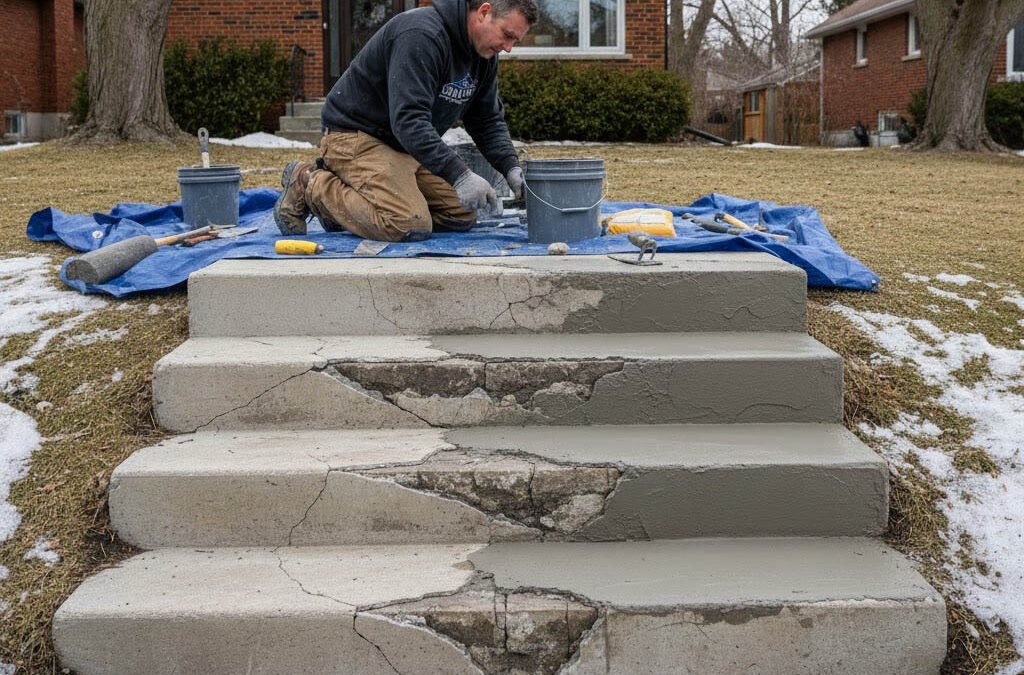
Concrete steps with more than two risers require footings to frost depth per the OBC. Steps with one or two risers may rest on grade. This is a commonly overlooked requirement — many older Ottawa homes have front steps that weren’t properly footed, which is why heaving and cracking of front steps is so prevalent across the city.
Permits and Inspections in Ottawa
Nearly every footing project in Ottawa requires a building permit. The City of Ottawa requires permits for new foundations, additions, attached decks, and any structural work. The permit process ensures your footings meet code and protects your investment. Expect two key inspections: a pre-pour inspection (after excavation, before concrete) and a backfill inspection (after the footing and foundation wall are complete, before covering). Your contractor should coordinate inspection timing to avoid delays — failed inspections require rework at your expense if the contractor missed specifications. Always confirm your contractor is familiar with City of Ottawa permit processes and requirements, and that they carry liability insurance and WSIB coverage. Ontario’s Consumer Protection Act requires written contracts for home renovation work over $50.
Choosing a Footing Contractor in Ottawa
Footing work is structural — the consequences of poor workmanship don’t appear immediately but can be catastrophic years later when settlement cracks appear, walls bow, or floors slope. Choose a contractor with specific foundation and footing experience, not a general handyman. Confirm they understand Ottawa’s soil conditions (particularly Leda clay), carry proper insurance, and have a track record of passing City of Ottawa inspections. A reputable contractor will pull the permit themselves, coordinate inspections, provide a written warranty, and use air-entrained concrete from a local batch plant — not bags mixed on site. For complex projects or poor soil conditions, an independent geotechnical report ($1,500–$3,500) can identify soil bearing capacity and recommend the correct footing design, potentially saving you from expensive problems down the road. Proper drainage around the completed footings and waterproofing of the foundation above are equally important for long-term structural health.
Frequently Asked Questions
How much do concrete footings cost in Ottawa?
Residential footings cost $5–$18 per linear foot installed, with most projects falling in the $8–$12/lin ft range. A typical deck footing project (6–8 sonotube piers) runs $500–$2,000. Continuous footings for a garage or addition cost $1,500–$3,600. Full house foundation footings range from $3,000 to $8,000 or more depending on size, soil conditions, and site access.
How deep do footings need to be in Ottawa?
The Ontario Building Code requires a minimum depth of 1.2 metres (4 feet) below finished grade for all structural footings in Ottawa. This places the bearing surface below the frost line to prevent frost heave. In areas with poor soil or high water table, engineering may recommend deeper placement up to 1.5 metres. The footing must also bear on undisturbed native soil, not backfill.
Do I need a permit for footing work in Ottawa?
Yes, almost all footing work in Ottawa requires a building permit from the City of Ottawa. This applies to new foundations, additions, attached decks, and any structural work below grade. The permit process includes pre-pour and backfill inspections. Small freestanding decks under the OBC exemptions may not require a permit, but confirming with the city before starting is always recommended.
What is the difference between a footing and a foundation?
A footing is the wider, thicker base that sits at the bottom of the foundation, distributing the building’s weight over a larger area of soil. The foundation wall sits on top of the footing and extends up to grade level. Think of it like a shoe: the footing is the sole that spreads your weight, and the foundation wall is the upper portion. Both are critical, but the footing must be installed first and correctly — everything else depends on it.
What size rebar do I need in footings?
Standard residential footings require a minimum of two #4 (½”) rebar bars running continuously along the length, positioned in the bottom third of the footing with at least 75 mm (3″) of concrete cover on all sides. Vertical #4 or #5 dowels are placed every 4 feet to tie the footing to the foundation wall above. Wider or more heavily loaded footings may require additional bars or larger sizes per engineering specifications.
Can I pour footings in winter in Ottawa?
It is possible but significantly more expensive and risky. Concrete must be kept above 10°C during pouring and above 5°C for at least 72 hours to cure properly. Winter pours require heated enclosures, insulated blankets, hot water in the mix, and sometimes accelerating admixtures. Frozen ground must be thawed before excavation. The best season for footing work in Ottawa is May through October when temperatures naturally support proper curing.
How wide should a residential footing be?
The OBC requires the footing to project at least 100 mm (4″) beyond each face of the foundation wall. For a standard 200 mm (8″) foundation wall, this means a minimum footing width of 400 mm (16″). However, actual width depends on soil bearing capacity and building loads. On weaker soils (common in parts of Ottawa with Leda clay), wider footings — 20″ to 24″ — may be required to distribute the load safely without exceeding the soil’s bearing capacity.
Does a deck always need footings below the frost line?
Not always. The OBC provides an exemption for freestanding decks that are one storey, under 55 square metres, no more than 600 mm off the ground, not supporting a roof, and not attached to the house. These decks may use surface-resting blocks. However, any deck attached to the house, higher than 600 mm, or supporting a roof structure requires frost-depth footings with full permit and inspection. The City of Ottawa has allowed freestanding decks using deck blocks up to 5 feet above grade in some cases.
How long do concrete footings take to cure?
Concrete reaches approximately 70% of its design strength in 7 days and full strength (typically 20–25 MPa for residential) at 28 days. Foundation walls can usually be poured on top of footings after 2–3 days in warm weather (above 15°C) or 5–7 days in cooler conditions. However, backfilling against foundation walls should wait until the concrete reaches sufficient strength to resist the lateral soil pressure — typically 7 days minimum. Your contractor should manage the construction sequence to respect these curing timelines.
What happens if footings are not deep enough?
Footings placed above the frost line in Ottawa will eventually be affected by frost heave — the upward force created by freezing soil moisture. This can crack the footing, shift the foundation wall, cause uneven settling, jam doors and windows, and create structural cracks in the building above. Repairs to an inadequately footed structure are far more expensive than proper footings from the start, often requiring underpinning ($350–$600/linear foot) to extend existing footings to the correct depth.
Every Great Structure Starts Below Ground
Ottawa Masonry — Code-compliant footings engineered for Ottawa’s frost depth and soil conditions.
Serving Ottawa, Kanata, Barrhaven, Orleans, Nepean, Gatineau & surrounding areas.
📞 (613) 454-8186